 Relfections on Cathedral Pride 2026 from the Convenor, Dr Scott Golden CJR
On a hot June evening, people crossed the threshold of Christ Church Cathedral carrying very different histories with the Church. Some came easily, with joy and expectation. Others came more cautiously, perhaps with memories of hurt, silence, exclusion, or prayers once offered through gritted teeth. For many LGBTQ+ people and their families, entering a church is not always a simple thing. It can mean crossing a threshold shadowed by memory, caution, grief, or hope. Last week, in Christ Church Cathedral, that threshold was widened.
Hundreds gathered for Choral Evensong celebrating LGBTQ+ Pride Month. They came from Dublin and beyond, from across this island, from different churches and traditions, and from very different relationships with faith. What they encountered was a service of great beauty, dignity and pastoral depth.
The hymns, readings and prayers dovetailed like a beautifully crafted chiffonier, handmade by an expert cabinetmaker: every part distinct, every part necessary, and every part held together with care, grace and purpose. The Cathedral Choir surpassed itself, as though it had, quite literally, pulled out all the stops for the occasion. In the great Anglican tradition, beauty did not distract from truth; it carried it.
The service opened with the language of companionship: “Brother, sister, let me serve you.” Psalm 139 reminded us that we are searched, known, formed and loved by God. Galatians proclaimed that in Christ the old divisions cannot have the final word. Matthew brought us back to the commandments on which everything else depends: love of God and love of neighbour. Later, the prayers remembered those wounded by exclusion, silence and hatred, and dared to speak of “the holy disruption of Pride”.
That phrase matters. Pride, at its best, is indeed a holy disruption. It interrupts shame. It interrupts silence. It interrupts the old habit of speaking about LGBTQ+ people as problems to be managed rather than souls to be cherished.
At the centre of the service was Dean Dermot Dunne’s sermon, one of his final sermons before retirement. It was the fulcrum on which the evening turned. He spoke of the universal human longing to belong: the longing to know that we are seen, welcomed and loved. Beneath the politics, beneath the anxiety, beneath the arguments that so often consume the Church, he reminded us that this longing is not peripheral to Christian faith. It runs right through Scripture.
When Jesus gathered people around his table, Dermot said, he gathered the excluded, the uncertain, the misunderstood and the wounded. When Paul wrote that in Christ there is neither Jew nor Greek, slave nor free, male nor female, he was not erasing difference, but proclaiming that our belonging to God is deeper than any category by which society divides us.
That is not a sentimental message. It is a profoundly challenging one. The Church, like every human community, is tempted to become tribal. Communities can nurture dignity and solidarity, but they can also become rigid, defensive, and over-dependent on defining who is in and who is out. Dermot invited us towards a different kind of Church: one where complexity is not feared, questions are not silenced, human dignity is never conditional, and people encounter grace before judgement.
The effect of that message was visible afterwards, not in any grand or theatrical way, but in the small human signs by which one knows that something has landed: people lingering, speaking more softly than usual, wiping away tears, embracing, asking when they might come again. They did not simply leave saying that the music had been fine or the service well arranged, though both were certainly true. They spoke of being moved. They spoke of feeling welcomed. They spoke of wanting to return.
There were stories, too — quietly shared, and not mine to tell in detail — which revealed why services like this are not ornamental, but necessary. Some present had come with complicated or wounded relationships with faith. Others carried memories of rejection by family, church, or community. Some were there for those they love; others were there for the parts of themselves they had long been told to hide. And some carried grief almost too deep for words: the memory of partners lost to suicide after rejection had helped make life unbearable, in one case from family, in another from the Church. What many seemed to find, in different ways, was a welcome they had not dared to expect, and a reason to wonder whether the Church might yet be a place of belonging.
These are not abstractions. They are the human reality behind ecclesiastical debate. When the Church speaks carelessly, people bleed. When the Church opens its doors with courage and sincerity, people breathe again.
That is why Christ Church Cathedral’s Pride Service matters. It does not take place in a vacuum. It takes place within a Church still divided, still anxious, and still too often willing to speak about LGBTQ+ people rather than with them. Only last year, the Cathedral’s invitation to Bishop Bonnie Perry, Bishop of Michigan in The Episcopal Church, to preach at its Pride Service drew public criticism from Bishop David McClay of Down and Dromore. That controversy should not be airbrushed from memory, not because we need to rehearse grievance for its own sake, but because reconciliation cannot be built on pretence.
Nor should the painful experiences of faithful LGBTQ+ Christians and allies within our own structures be allowed to disappear into the small print of Church politics. If the Church wishes to heal, it must tell the truth not only about the hurt endured by LGBTQ+ people in society, but about the wounds inflicted within its own household of faith. We cannot speak credibly of welcome while refusing to examine the ways in which our own language, structures and silences have excluded, shamed or diminished those who came seeking bread and were too often given stones.
The pride service was, therefore, not merely a pleasant evening, nor even simply a moving farewell tribute to a much-loved Dean. It was an act of witness. It said, in music, Scripture, prayer and preaching, that LGBTQ+ people are not guests on sufferance in the household of God. They are not pastoral problems. They are not footnotes to someone else’s theology. They are beloved of God.
Matty Zaradich, who shaped the service with such care, deserves heartfelt congratulations. Anyone who has spent long hours compiling liturgy knows the judgement involved: tone, balance, rhythm, theology, music, pastoral instinct, and the unseen attention to detail that a congregation may not consciously notice but certainly feels. Last Thursday, we felt it.
There was also something deeply fitting in the presence of Canon Ginnie Kennerley, one of the great ecclesiastical pioneers of the Church of Ireland: among the first women deacons, the first woman rector, and the first woman appointed canon of an Irish cathedral — Christ Church itself. Her presence was a reminder that what once seems unthinkable can, through courage, grace and persistence, become part of the Church’s story.
But progress is never automatic. It must be chosen. Again and again, it must be chosen.
Christ Church Cathedral’s Pride Evensong showed what that choice can look like. Not slogan, but sacramentality. Not culture war, but compassion. Not a narrowing of the Gospel, but a widening of the table.
In the end, perhaps the most powerful thing about the evening was very simple: people wanted to come back. People who had been wounded wanted to come back. People who had doubted there was a place for them wanted to come back. People who had arrived tentatively left with some new sense that the Church might yet be capable of grace.
That is not a small thing. That is mission. That is evangelism. That is, in the deepest sense, the work of the Gospel.
The final hymn prayed that we might be “changed from glory into glory” and lost in “wonder, love and praise.” Last Thursday, in Christ Church Cathedral, that was not merely sung as aspiration. For a precious hour and a half, it became visible: in welcome, in courage, in beauty, and in the widened embrace of God.
And may that embrace grow wider, wider, and wider still.
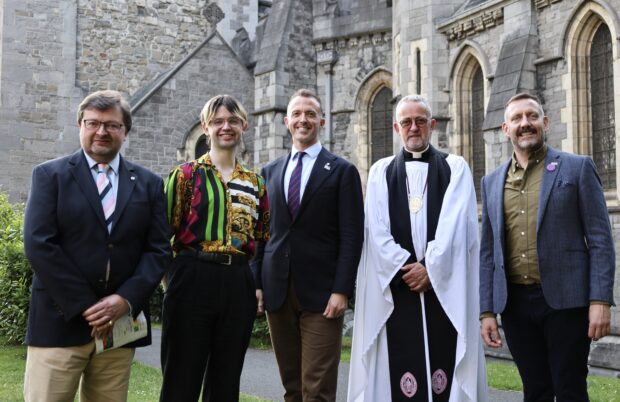
From left: Dr Scott Golden CJR of Changing Attitude Ireland, Caleb O’Connor PhD of OutHouse, Matty Zaradich of the Community of St Laurence, Dean Dermot Dunne and the new CEO of BelongTo, Kieran O’Donovan, at Christ Church Cathedral’s Pride Evensong 2026.
Photo: Lynn Glanville.